
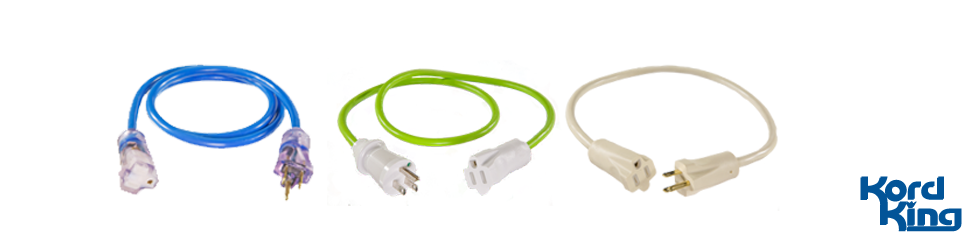
For more than 35 years, Kord King has been the industry leader in manufacturing the highest quality power cords (See About Us). We have extension power cords for every type of medical power supply need, as well as heavy duty and construction grade cord sets.
Our extension cords are manufactured in the USA in a variety of colors, lengths, NEMA plug types, wire sizes. Additionally, there options for in-line rocker switch (link), lighted ends, cord grip and identification.
Extension cords are power cords that have the same configuration on both ends of the cord but are opposite “genders”. For instance, a standard extension cord one might see in a department store would be a NEMA 5-15P (male plug) to a NEMA 5-15R (female receptacle). In a literal sense, the outlet is “extended” to the length of the cord.
Detachable cords are power cords that have different configurations from one end to the other. A great example is the very popular medical-grade power cord with a NEMA 5-15P Hospital Grade plug to an IEC 60320 C13 connector. These types of cords are ideal for powering equipment and are simple to install, since they are not hard-wired. They can, therefore, be “detached” from the wall and equipment.
All forms of extension/detachable cords are ideal for fast-paced environments where cords can be easily damaged by foot or motor traffic. Users are able to replace damaged cords, which is relatively inexpensive compared to machine repair and much less time-consuming.
The Electrical Safety Foundation International has developed a lot of great informative articles to help prevent injuries, property damage and fatalities resulting from improper use of electrical components. See their infographic for proper Extension Cord usage. Kord King builds exceptional products, but there is nothing more valuable than knowledge!
Please see below for a sampling of the types of extension/detachable cords we can manufacture. It is not exhaustive, so if you do not see what you need, send us a message, or give us a call.
Kord King normally manufactures their extension power cords with quick turnaround times of 1-2 weeks.
Extension Cord Configurations
Extension cords use identical NEMA patterns on both ends, with opposite genders to extend the reach of an outlet. A common example is a NEMA 5 15P plug paired with a NEMA 5 15R receptacle. This configuration allows the outlet to be “extended” to the length of the cord while maintaining the same electrical rating and compatibility.
These cords are available in multiple wire sizes, molded colors, and lengths. Options include lighted ends for visibility, cord grip features for mechanical reinforcement, and in line rocker switches for equipment that requires local on/off control.
Detachable Cord Configurations
Detachable cords use different connector types on each end. A typical example is a NEMA 5 15P plug paired with an IEC 60320 C13 connector, commonly used on medical and electronic equipment. These cords allow devices to be powered without permanent wiring, supporting quick replacement and simplified maintenance.
Detachable cords are widely used in environments where cords may be damaged by foot traffic, carts, or equipment movement. Replacing a detachable cord is significantly faster and more cost effective than repairing or rewiring the equipment itself.
Use Case Considerations
Extension and detachable cords are selected for:
- Medical equipment
- Laboratory devices
- Commercial appliances
- Portable tools
- Office equipment
- Environments with frequent cord movement
- Applications requiring quick replacement
These cords support equipment mobility, reduce downtime, and simplify maintenance workflows.
Selection Framework for OEM and Facility Use
When specifying an extension or detachable cord, engineers and facility teams typically evaluate:
- Required NEMA pattern or IEC connector
- Wire gauge relative to amperage rating
- Cord length and routing requirements
- Need for lighted ends or in line switches
- Color coding for identification
- Strain relief or cord grip requirements
- Replacement frequency and environmental exposure
These factors ensure proper fit, electrical compatibility, and long term reliability.
FAQ
What Is the Difference Between an Extension Cord and a Detachable Cord?
An extension cord uses the same NEMA pattern on both ends with opposite genders, while a detachable cord uses different connector types to power equipment without hard wiring.
Why Are Detachable Cords Common in Medical and Electronic Equipment?
They allow fast replacement when cords are damaged or worn, reducing downtime and avoiding the need for internal wiring repairs.
Which Features Can Be Added to Extension or Detachable Cords?
Options include lighted ends, in line rocker switches, cord grip reinforcement, and molded color variations for identification.
How Do Wire Size and Amperage Rating Affect Cord Selection?
Wire gauge determines the current the cord can safely carry. Selecting the correct size ensures proper electrical performance and prevents overheating during operation.