
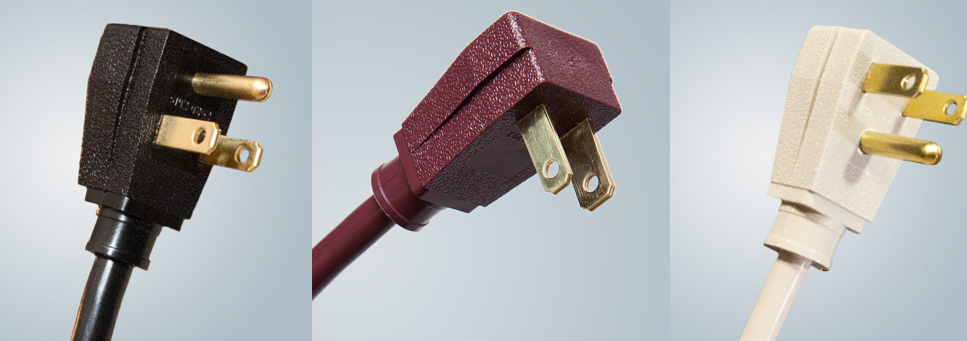
Right Angle Plugs Technical Data Chart
Plug Types Technical Data
| C/US CSA | Product Name | NEMA | UL | CSA | C/UL | Catalog # |
|---|---|---|---|---|---|---|
|
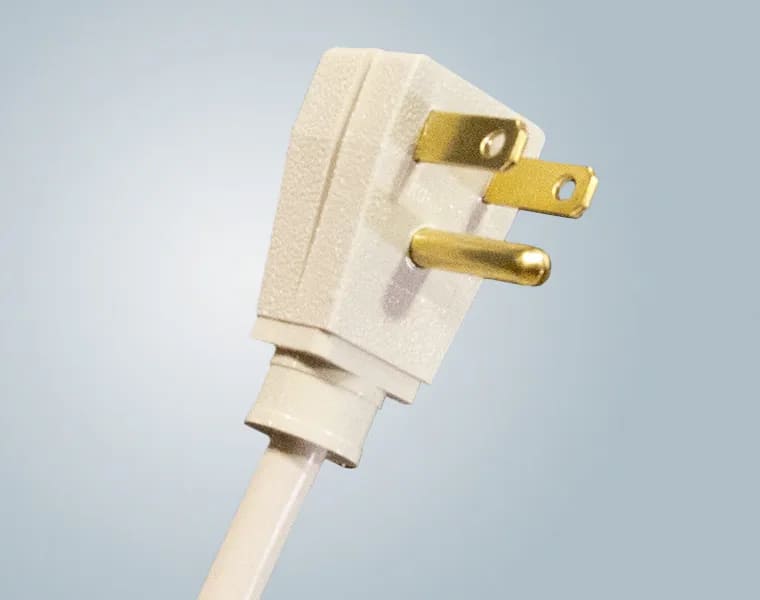
Right Angle Plug / Pin at Bottom 5-15P |

|
X | X | X | KK7000 |
|
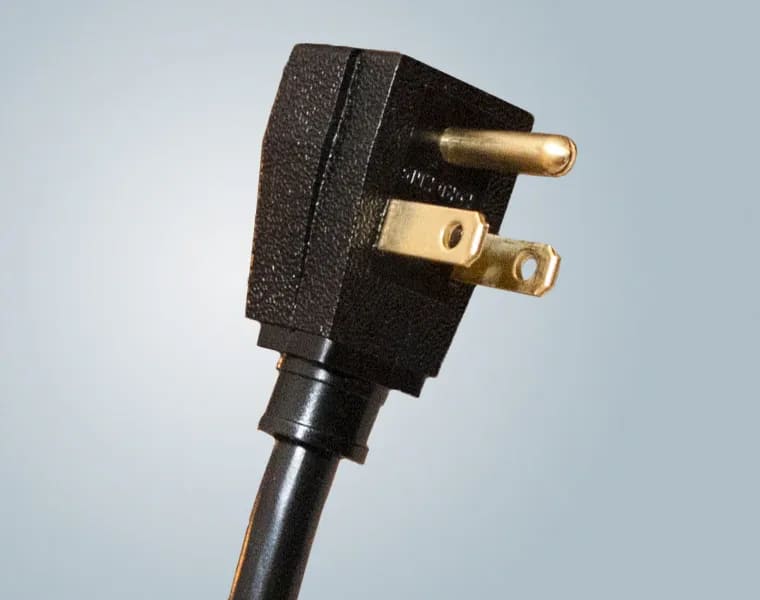
Right Angle Plug / Pin at Top 5-15P |
|
X | X | X | KK8000 |
|
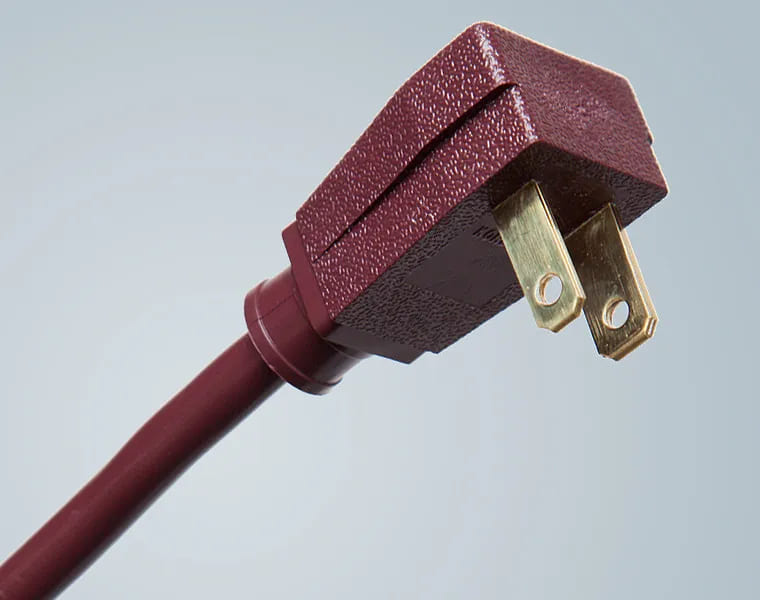
Right Angle Plug 1-15P |

|
X | X | X | KK9000 |
** Available in a variety of wire types **
Right Angle Power Cord Technical Data
| Plug Type | Wire | Amps | Voltage |
|---|---|---|---|
| NEMA 5-15P RAT (Top) | 18/3, 16/3, 14/3 | 10, 13, 15 | 125 |
| NEMA 5-15P RAB (Bottom) | 18/3, 16/3, 14/3 | 10, 13, 15 | 125 |
| NEMA 1-15P | 18/3, 16/3, 14/3 | 10, 13, 15 | 125 |
** Available in a variety of wire types **
These standard right angle power cords and cordsets are widely used in the appliance industry where tight space requirements and safety issues are common. Right angle cords are available in both the NEMA 5-15P, 3-conductor and NEMA 1-15P, 2-conductor (standard or polarized) configuration.
All Kord King’s right angle power cords are U.L. listed and C.S.A. approved. Our molded, ergonomic plugs have an extra-large head with deep contoured ridges for easy, non-slip handling, and, they also feature a heavy-duty strain relief.
Right Angle Plug Variants
Right angle plugs are offered in three primary configurations:
- NEMA 5 15P, Pin at Bottom (RAB or BRAB)
- NEMA 5 15P, Pin at Top (RAT or BRAT)
- NEMA 1 15P, Two Conductor
These options allow OEMs to match plug orientation to enclosure design, cord exit direction, and user access requirements. The molded plug head includes deep contoured ridges for secure handling and a reinforced strain relief structure to support long term durability.
Electrical and Mechanical Characteristics
Right angle power cords are available in amperage ratings of 10, 13, and 15 amps at 125 volts. Wire options include 18/3, 16/3, 14/3 & 12/3 for grounded versions, and the same wire sizes for ungrounded versions depending on configuration. The angled plug design reduces bending stress at the outlet and helps maintain conductor integrity in tight installations.
All configurations are UL listed and CSA approved, supporting use in regulated environments. The molded PVC plug body provides mechanical stability, while the integrated strain relief protects the conductor bundle during repeated bending or tension.
Orientation and Fit Considerations
The orientation of the grounding pin determines how the cord exits the outlet. Top pin and bottom pin versions allow the cable to route upward or downward depending on equipment layout. This is especially useful in installations where:
- The device sits flush against a wall
- Adjacent outlets must remain accessible
- Cable routing must avoid vents, hinges, or moving parts
- The equipment requires a defined cord path for strain management
Selecting the correct orientation ensures proper fit and reduces interference with surrounding components.
Application Areas
Right angle power cords are used in:
- Appliances
- Consumer electronics
- • Compact equipment
- Under counter installations
- Wall mounted devices
- Multi outlet environments
- Equipment requiring controlled cord direction
The angled plug design supports installations where clearance and routing must be managed efficiently.
FAQ
How Does Pin Orientation Affect Cord Routing?
Pin orientation determines whether the cord exits upward or downward when inserted into a receptacle. This allows engineers to match the plug layout to the equipment’s physical design and available clearance.
Which NEMA Patterns Are Offered for Right Angle Plugs?
Right angle plugs are available in NEMA 5 15P for grounded applications and NEMA 1 15P for two conductor devices that do not require grounding.
What Wire Sizes Are Compatible with Right Angle Power Cords?
Wire options include 18/3, 16/3, 14/3 & 12/3 for grounded versions, with similar sizes available for ungrounded versions depending on amperage requirements.
Why Are Right Angle Plugs Used in Appliance and Compact Equipment Designs?
The angled plug reduces the space required behind the device and directs the cord along a predictable path, supporting installations where clearance and routing must be controlled.